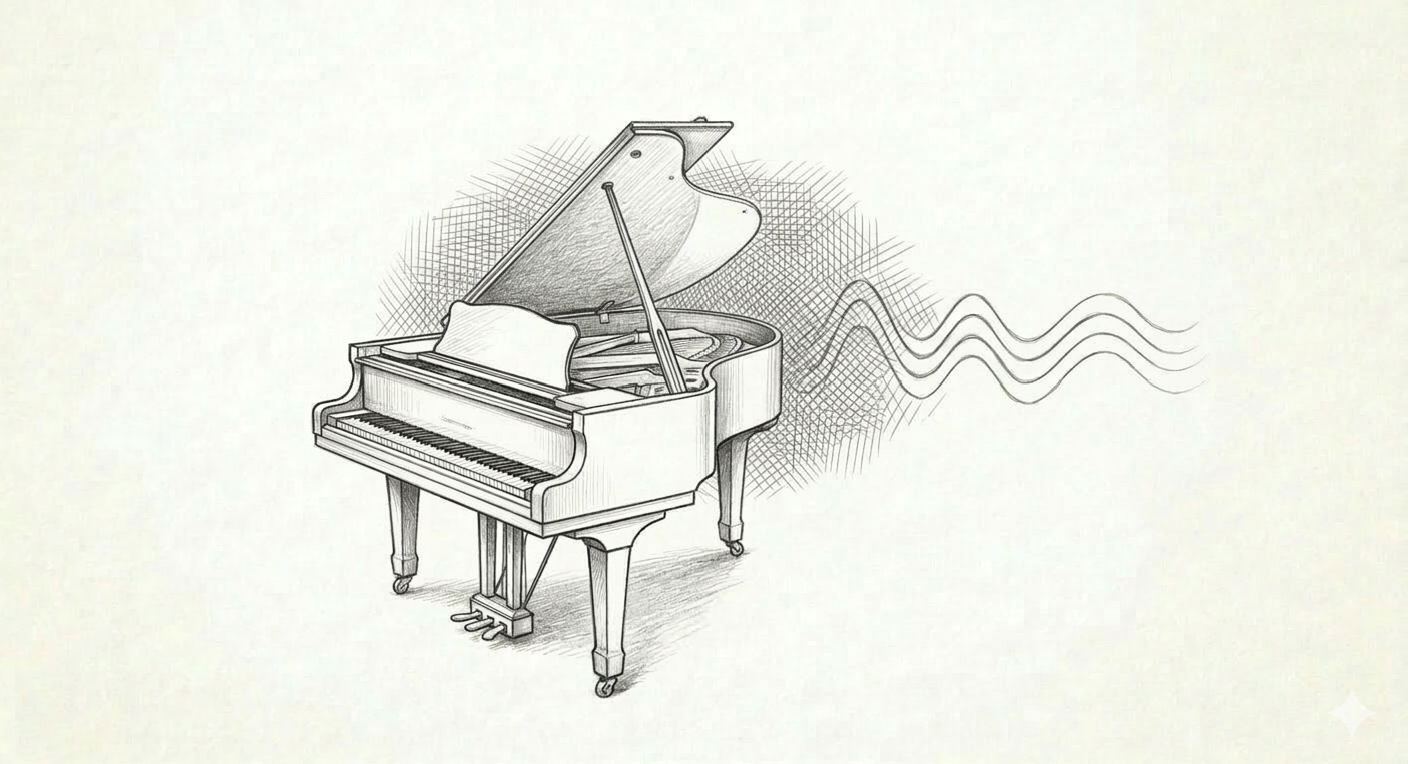
Central Coast Piano
Tuning · Ear Playing · Monterey to the Bay
The Work
Piano tuning and ear-playing instruction might seem like different worlds, but they share the same root: a deep listening. Whether coaxing a string into tune or unlocking a chord by feel, the ear is always the guide. You already have one — we just develop it together.
The Tuner
Tuning is a meditative act. The moment a piano moves from discordance into resonance is genuinely joyful — and that joy is present in every appointment. There's also the quiet delight of sitting down to play an instrument freshly brought to life, especially one never played before.
The Teacher
Learning to play by ear is one of the most liberating things a musician can do. The approach connects especially well with kids — there's something natural about learning to trust what you hear before you read what you see. But this path is open to anyone at any age.
Where We Are
Service runs from Monterey up through the Bay — Fremont, San Mateo, Gilroy, and everywhere in between. If you have a piano that needs care, or a student who is ready to unlock their ear, the drive is worth it. Reach out and let's make it happen.
"Every piano is waiting to be heard properly — and every player has music inside them that hasn't found its way out yet. Both of those things can change."
A well-tuned piano doesn't just sound better — it feels different to play. The resonance between strings, the way chords bloom and sustain, the confidence a player feels when the instrument responds truly. Tuning is the foundation everything else is built on.
For pianos that are tuned somewhat regularly, slightly out of pitch, or have a handful of keys with a tinny sound. A tuning in these cases will bring the instrument into its full resonance. This usually takes about two hours, done with care and genuine enjoyment. There is real satisfaction in handing a piano back to its owner in a state of harmony.
When a piano has been out of tune for a long time or is significantly below pitch, it needs to be raised to tension before a fine tuning can hold. This is a two-pass process — bring the strings up, then tune them true. It takes more time, more skill, and rewards you with a piano that stays in tune much longer.
One of the quiet pleasures of this work is sitting down at the end of a session and playing the piano — especially one played for the first time. A freshly tuned piano has a kind of aliveness to it. You'll hear it too, the first time you play after a tuning. That difference is real, and it matters.
There are three service levels to consider. A pitch raise is for pianos that haven't been tuned in a long time — every key must be raised, sometimes twice, before it holds. A standard tune is for a piano tuned once every couple of years, where most keys need adjustment. A touch-up addresses a handful of strings that tend to go flat before the others, often due to an aging tuning pin — these are half price, and one is included within a year of a first tune with Central Coast Piano.
Ear playing is different from reading music, though they are not mutually exclusive. Knowing one enhances the knowing of the other. But those who carry the skills, knowledge and techniques to be an 'ear player' reap the rewards of not relying on sheet music and can have an almost unlimited set list. My students end up being the special few that can walk into a room with a piano and fill it with music and all its magic. Very early in the process they will be able to play accompaniment to support vocalists or instrument players — ukulele, guitar, any instrument — starting with Happy Birthday and ending with Christmas carols. Playing accompaniment is a great joy waiting to be had!
With even modest practice — 60 to 90 minutes a week, on your own terms — a student can start to play the bass, accompaniment, and melody of songs and put on a real show.
Music reading is woven in quietly throughout — students naturally learn to read notes and combine them with the chord symbols found in most scores.
Students are also able to play along with their favorite songs from their phone or a speaker. The Beatles are a particularly fun group to jam with!
These methods support composition too. Just the act of experimenting with different rhythm patterns combined with different chord progressions and a pinch of dynamics — and suddenly a song emerges.
After assessing the student's ability to discern which of two notes is higher in pitch, we begin with the foundations: major scales and chord types. The four most-used chord types are introduced — major, minor, and 7th chords. It is emphasized that learning these four basic chord types for a single note, such as C, means the student is empowered to play the same types for every other note on the piano. That unlocks 352 chords across all the keys. Solfege is introduced through Do-Re-Mi from The Sound of Music, and fingering is demonstrated as a path to simplicity.
Students learn that most songs can be played with just 3 or 4 chords, and that many follow a 1-4-5 pattern. This opens the door to chord inversions — the same chord voiced in three or more positions across an octave.
Fun drills introduce the student to using both hands with differing rhythm patterns. Fingering begins to be emphasized for both scales and inversions, and the distinct fingering for multi-octave scales is introduced.
This is where it gets exciting. We take songs most students already know — Happy Birthday, The Alphabet Song (same melody as Twinkle Twinkle Little Star), Brahms' Lullaby, The Lion Sleeps Tonight, Heart and Soul, and seasonal favorites like Jingle Bells and Silent Night — and learn to hear and play them using the 1-4-5 pattern.
There's something about the ear-playing approach that connects naturally with kids — it meets them where music already lives in their bodies, before notation adds complexity. But adults thrive here too. If you've always wanted to just play without needing sheet music, this is your path. You're more ready than you think.
More complex chord types are introduced and made approachable, and creativity gets a big boost with the introduction of minor scales.
The feelings evoked by playing forte (loud) versus piano (soft), a change of tempo, modulation (changing key), shifting octaves, sustains and staccatos — all of these can be arranged to paint the canvas of your very being in a way like no other. Music is magic, and this final layer makes you a magician.
A few words from those who have sat at the bench — or whose children have.
Tim has that important quality when working with kids, making the learning fun! He can deliver complex ideas in easily digestible nuggets my kid gobbles up. We have only had a few sessions so far and my child is progressing very quickly and can't wait for the next one.
Tim did an outstanding job tuning our 1895 Baltimore upright piano, and the difference was immediate. He approaches his work with a rare combination of technical skill, musical intuition, and genuine care. Not only is he a highly skilled tuner, but he's also an incredibly talented by-ear pianist, which gives him an extra edge in bringing an instrument to life. Beyond the craftsmanship, Tim is simply a pleasure to work with — friendly, personable, professional, and clearly passionate about what he does. It's refreshing to meet someone who treats both the instrument and the homeowner with such respect. I can't recommend Tim highly enough.
Tim is one of the greatest teachers we have known. He has taught our 10 year old wonderful songs by ear in a short amount of time. The best part is that he makes it really fun and easy to learn. Can't recommend Tim enough!
Whether you have a piano that needs tuning or a student ready to start playing by ear — reach out. The Central Coast is covered from Monterey to Fremont, San Mateo, Gilroy, and beyond. Every note of this work is a pleasure, and it starts with a conversation.
"Thank you — I'll be in touch soon. Something good is coming."
Service Area
Monterey · Pacific Grove · Carmel · Salinas · Santa Cruz · Gilroy · Morgan Hill · San Jose · Fremont · San Mateo · and the roads between
Tuning Rates
Standard Tune-Up · $175
Pitch Raise + Tuning · $250
Touch-Up · $75
Each appointment is an unhurried, joyful session. The piano gets the time it deserves.
Lesson Rates
Ear Playing Instruction · $60 / hr
All ages and levels welcome. Especially resonates with kids, but the ear has no age limit. You are more musical than you know.
A Note
This work is done with genuine love. Every tuning is a small act of restoration. Every lesson is an invitation to trust what you already hear. The best way to begin is simply to reach out.